


Agile Connect Event – May 21, 2026: interactive inspiration!
Zonder categorie
Thursday, May 21, it’s time again for our next Connect Event. From 3:00 PM to 5:00 PM, we’re hosting this event fully online, interactive, and inspiring.
Whether you’re in the middle of a transformation or simply curious about how other organizations are becoming more agile, this event is the place to exchange experiences, ask questions, and help each other move forward.
What can you expect?
During this interactive event:
- You can bring in your own questions or propositions (no obligation!).
- You help others with their challenges – your experience matters.
- You discover new perspectives and practical solutions.
- You meet professionals from other organizations who, like you, are working on change.
Whether you’re a certified Agile Champion or simply someone who creates movement within your team or organization: you are more than welcome. And feel free to bring a colleague – the more perspectives, the richer the conversation.
Sign up?
Here’s the link to register: https://amigos.nu/event/online-agile-connect-event-21-mei/
Let’s support and inspire each other. See you on May 21!
Ontvang onze updates
Vul je e-mailadres in en ontvang 1x per maand een update in je mail met alle blogs die geplaatst zijn op onze site.


AMIGOS at “kijkje in de keuken DRIVE”
Zonder categorie
On Thursday, April 9, AMIGOS attended “kijkje in de keuken DRIVE” event. Participants could visit AMIGO Els for the workshop: From resistance to responsiveness.
This workshop explored: “Dealing with change – how hard can it be?”
Changes in organizations are happening faster and faster. New strategies, reorganizations, new ways of working… we all have to deal with them. But let’s be honest: most people don’t really like change.
We often say we’re flexible. But as soon as something truly changes outside our sphere of influence, we feel resistance. Why does that happen? And how can you deal with it more effectively?
During this interactive session, Els helped participants experience how their response to change actually works. This leads to practical insights. You’ll learn:
- Why resistance to change is completely human
- Why resistance can sometimes even be useful
- How to gain more control over changes you have little influence on
- How to help yourself and others become more adaptable
Would you like to experience a workshop like this and discover how to move from resistance to responsiveness?
We also offer in-house workshops, see: https://amigos.nu/en/inhouse-events-2/
For an impression of the event: “kijkje in de keuken DRIVE”, see: https://www.linkedin.com/feed/update/urn:li:activity:7450172164625821696/
Ontvang onze updates
Vul je e-mailadres in en ontvang 1x per maand een update in je mail met alle blogs die geplaatst zijn op onze site.

AMIGOS running for Trees
Zonder categorie
From time to time, we organize or highlight events from AMIGOS and for AMIGOS (our friends of change), and participate in them together. One such event was the City-Pier-City run in The Hague on March 15, 2026. Amigos Edwin and Jeroen took part, wearing the recognizable Running for Trees running shirts. It was a sunny, enjoyable day and a great way to connect.
Keep an eye on the events page, or share tips about events you’re participating in yourself, so we can add them as well and continue finding each other there.
Ontvang onze updates
Vul je e-mailadres in en ontvang 1x per maand een update in je mail met alle blogs die geplaatst zijn op onze site.

Recap Agile Connect Event – February 26, 2026
Zonder categorie
Last Thursday, we hosted another online Agile Connect event. It was great to exchange experiences with different champion groups and organizations about both successes and challenges. Each time, it’s inspiring to learn from one another and engage in meaningful conversations about continuous improvement.
Couldn’t join this time? No worries, the next edition will take place on May 21! You can already register via:
https://amigos.nu/event/online-agile-connect-event-21-mei/
By participating in this regular cadence, you give yourself and your organization a recurring boost in continuous improvement.
This edition was extra special because several participants joined for the first time. I continue to be amazed at how many practical ideas are shared in such a short amount of time, ideas that participants can immediately apply in their own practice. It was also great to see the book : Expedition Agility, with its islands, ballast, treasures, and message-in-a-bottle metaphors, being used during the event to introduce ideas. There were many clear connections to topics participants had previously encountered in the champion program.
The book has been part of the champion program since 2025, so participants who joined before then may not yet know it from the program. Events like these show how the champion community stays up to date with new developments, including the availability of practical information on the renewed AMIGOS website:
On the website, events are now even more visible, making it easy to register for future gatherings, and there’s more than just the Connect events and trainings.
So keep an eye on the website, subscribe to the newsletter, and if you have ideas for organizing something together, let us know.
See you next time (again) at a Connect event! Don’t forget that as a champion, you’re welcome to bring a guest. And if you’d like to join but are not yet part of the community, feel free to contact us to explore how you can get involved. An ideal moment to join the community is the start of the upcoming champion program in April. There are still a few spots available. Do you know someone for whom this would be a great fit? Let them or us know!
Ontvang onze updates
Vul je e-mailadres in en ontvang 1x per maand een update in je mail met alle blogs die geplaatst zijn op onze site.

Agile Connect Event – 26 February 2026: Join the conversation, share your insights!
Zonder categorie
It’s time once again to come together and talk about Agile in practice. On Thursday 26 February, from 15:00 to 17:00, we are hosting a new Agile Connect Event — fully online, interactive and inspiring.
Whether you are right in the middle of a transformation or simply curious about how other organizations are becoming more responsive, this event is the place to exchange experiences, ask questions and help each other move forward.
What can you expect?
During this interactive event you can:
- Bring your own questions or statements to the table (no obligation!).
- Support others with their challenges — your experience matters.
- Discover new perspectives and practical solutions.
- Meet professionals from other organizations who, just like you, are working on change.
Whether you are a certified Agile Champion, or simply someone who creates momentum within your team or organization — you are very welcome. And feel free to bring a colleague; the more perspectives we have, the richer the conversation becomes.
Sign up
Here is the registration link:
https://amigos.nu/event/online-agile-connect-event-26-februari/
Let’s support and inspire each other.
See you on 26 February!
Ontvang onze updates
Vul je e-mailadres in en ontvang 1x per maand een update in je mail met alle blogs die geplaatst zijn op onze site.

Change capability as an internal skill
Zonder categorie
Many organizations have been on a journey for quite some time to become more responsive, predictable and value-driven. Significant investments have often been made in change capability. However, that capability still tends to focus primarily on doing agile: frameworks, rituals and roles, and too little on being agile: mindset, behaviour and ownership.
In a mature transformation, capacity shifts from change specialists to change skills within the organization itself. Within the teams doing the work, as well as within (management) teams that provide direction. Responsiveness then stops being an externally introduced way of working and becomes an internal capability.
A simple yet sharp check of this maturity is the question, or rather, the experiment: how does the work progress when the specialists are not there? If everything comes to a standstill, dependency still exists. That insight provides valuable input for the next grow impulse.
By gradually reducing the involvement of specialists, it becomes clear what the learning journey should truly focus on. Not continuing to do the work for others, but transferring knowledge and strengthening ownership.
This requires a fundamental shift in role: from coach to capability builder.
That is exactly what the Champion Program is designed for. It develops people within the organization into carriers of change, champions who do not apply agility, but embody it. This is how sustainable change capability emerges, from within.
In April, a new programme will start. For more information, see: https://amigos.nu/en/learn/trainings/agile-champion-program/
It is also possible to design a tailored program within your organization.
We would be happy to explore the possibilities with you.
Ontvang onze updates
Vul je e-mailadres in en ontvang 1x per maand een update in je mail met alle blogs die geplaatst zijn op onze site.

Moving forward together: Towards a responsive 2026
Zonder categorie
On the final day of the year, it feels natural to pause for a moment.
To look back at what has been, to be grateful for what has emerged, and to look ahead to what may come.
To all our friends of change:
we already wish you a prosperous, healthy, and responsive 2026.
Looking back on a great 2025
For us, 2025 is a year we look back on with pride.
- Our book Expedition Agility (Expeditie Wendbaarheid) was included on the longlist for Management Book of the Year — a special recognition of the mindset and ideas we are shaping together with many others.
- We organized four successful Agile Connect Events, focused on connection, inspiration, and learning.
- And once again, we had the pleasure of welcoming two new groups of Agile Champions into our growing community of change-makers.
Every encounter, every conversation, and every step forward reinforces our belief: true agility is created together.
Looking ahead to 2026
In 2026, we will continue to build this movement.
- Agile Connect Events are already on the agenda.
👉 You can register now via:
https://amigos.nu/event/online-agile-connect-event-26-februari/ - And of course, new editions of the Agile Champion Program will start — for everyone who doesn’t just want to understand change, but also wants to lead it.
👉 View the planned programs here:
https://amigos.nu/leren/trainingen/agile-champion-programma/
New year’s resolutions? Embrace change
The start of a new year often comes with good intentions. In our view, they don’t have to be big or complicated.
- Embrace change
- Plan your participation in an Agile Connect Event
- Register for the Agile Champion Program — or recommend it to another friend of change
(If you act quickly, you can still start in January.)
Moving forward together: towards a responsive 2026
Together, we create impact. Step by step. Person by person.
Thank you for everything we were able to build together in 2025.
We look forward to connecting with you again in 2026.
Warm regards,
Your friends of change
Els, Edwin & Jeroen
Ontvang onze updates
Vul je e-mailadres in en ontvang 1x per maand een update in je mail met alle blogs die geplaatst zijn op onze site.

Change also brings opportunities
Zonder categorie
In the book Expedition Agility, you’ll find a variety of exercises designed to make the journey toward agility lighthearted and engaging. In each blog post, we highlight one of these practices to inspire you and invite you to experiment with it.
This time, we’re exploring the exercise “Change Also Brings Opportunities.”
Discover New Possibilities
Change often triggers resistance because it challenges us to let go of what feels familiar.
But what if we approached change as an opportunity — a chance to discover and add something new?
The exercise “Change Also Brings Opportunities” offers a playful and interactive way to explore this idea. By asking team members to make three small changes to their appearance — three times in a row — it becomes clear that change doesn’t just mean losing something, but also creating or adding something new.
This fun activity demonstrates that change isn’t only necessary; it can also be enjoyable and full of surprises. It’s a wonderful metaphor for change within teams and organizations: sometimes you discover far more possibilities than you first imagined.
The Exercise: Change also brings opportunities
- Ask team members to pair up and stand facing each other. Look at each other for a moment, then turn around so you’re standing back to back.
- Each person changes three things about their appearance. Wait until the signal is given, then turn around at the same time.
- Tell your partner what you notice has changed about their appearance.
- Repeat the exercise twice more. Each time, participants must change three different things about themselves. You’ll notice it gets harder with each round — until people realize they can also remove or add things (for example, take off a watch, add a post-it, or borrow a colleague’s glasses).
- During the reflection, ask what insights this exercise brought up. Usually, people realize they can change much more than they thought. Point out that change isn’t just about loss — it’s also about adding new elements, opportunities, and perspectives.
- Observe what happens next: right before and during the reflection, many participants start putting everything back the way it was. You can share this observation with the group — it shows how strong our tendency is to return to the old state. But why should we? Change can actually be fun! Invite people to keep their new look as it is for a while — which often leads to some good laughter!
After completing the exercise, it becomes clear that change has much more to offer than we often realize.
The laughter and lighthearted moments during the activity reveal an important lesson: you can change more than you think, and it doesn’t have to be complicated or heavy. Adding new elements — instead of just removing old ones — opens the door to fresh possibilities and opportunities.
You may notice that many people quickly try to undo their changes afterward. This shows our natural tendency to return to what’s familiar. But why not embrace the new instead? Change can be refreshing — even fun!
Let this exercise be an invitation to look beyond what you might lose and focus on what you can gain through change. Who knows — it might just be the beginning of something even better.
Source: Expedition Agility
By: Els Verkaik, Edwin Clerkx & Jeroen Venneman

Ontvang onze updates
Vul je e-mailadres in en ontvang 1x per maand een update in je mail met alle blogs die geplaatst zijn op onze site.

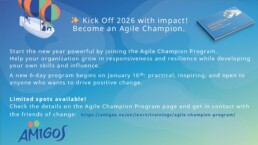
Will 2026 be the year of impact? Become an Agile Champion!
Zonder categorie
Agility is more important than ever, just look at the rapid developments and opportunities emerging around AI. For organizations to be successful today and in the future, an agile way of working is essential. Not just within certain teams or domains, but across the entire organization. True resilience and responsiveness must flow through the whole value chain and innovation system.
An agile way of working is more than implementing a framework. Real, effective agility requires a balance between the structure within organizations and the underlying culture. The balance between the upstream and the undercurrent.
Agile Champions are the driving force behind this continuously accelerating responsiveness.
In January 2026, a new group will start the Agile Champion Program, a 6-day learning journey for anyone who wants to strengthen agility, collaboration and the power of change within their organization.
Over the past years, hundreds of Agile Champions have completed this program. Many of them are now active in new organizations, organizations where we again see strong interest in developing internal change capability, breaking through stalled transformations, creating focus, accelerating progress, and embedding continuous improvement.
That’s why we are making a broad invitation.
1️⃣ Do you know someone, or are you working somewhere, where the Agile Champion Program might be relevant?
A new edition starts on January 16th.
The program is practical, inspiring and designed to empower people who want to carry and accelerate meaningful change.
Whether you are interested yourself or know someone in your organization or network: we’d love to hear from you. Sharing this information is greatly appreciated.
👉 More information:
https://amigos.nu/en/learn/trainings/agile-champion-program/
2️⃣ Looking for broader support in organizational transformation?
In addition to the Agile Champion Program, we also support organizations with:
- change and transformation initiatives,
- team development,
- and fully customized internal learning programs.
Together with organizations, we build sustainable growth and future-ready teams.
If you have questions, see opportunities, or would like to connect us to someone within your organization, we’re happy to explore the possibilities.
Together, we make agility human, achievable and inspiring.
Ontvang onze updates
Vul je e-mailadres in en ontvang 1x per maand een update in je mail met alle blogs die geplaatst zijn op onze site.

Recap: Agile Champions Connect – an afternoon full of energy, inspiration, and connection
Zonder categorie
On November 6, we hosted our annual in-person Agile Champions Connect — the event where Agile professionals come together to share knowledge, inspire one another, and celebrate the strength of our community. This year was no exception. With a wonderful mix of insights, practical stories, and personal experiences, it became an afternoon that will resonate for a long time.
A programme full of valuable sessions
We had the honour of welcoming several fantastic speakers, each offering their own unique perspective on change, collaboration, and growth within organisations:
- Erik Cremers – Business & Information Consultant at APG
Erik introduced us to the world of multi-team dynamics, the topic of his recently completed PhD. His insights into collaboration at scale inspired many to rethink how we can help teams thrive in complex environments. - Mark Heistek – Agile/DevOps Transformation Coach at Port of Antwerp-Bruges
Mark openly shared both the challenges and successes of the transformation within a large IT organisation. His experiences strengthening collaboration between business and IT offered fresh perspectives on sustainable change. - Karin van Ooijen – Transformation Coach at Allianz Direct
Karin invited us to explore how to inspire teams toward self-organisation, even within a Laloux Orange organisation. A session that was both thought-provoking and surprisingly relatable.
And of course, our Amigos Jeroen, Edwin, and Els, who brought great energy to the room:
- Jeroen Venneman – Transformation Consultant
Jeroen kicked off the event with an interactive opening and facilitated the programme all the way to the networking drinks. - Edwin Clerkx – Agile Coach
Edwin gave us a behind-the-scenes look at the Agile transformation at Brabant Water and, through a hands-on challenge, showed how powerful learning-by-doing can be. - Els Verkaik – Agile Coach at Schiphol Group
Els took us into the subcultures within organisations and helped us discover how to spark change, even when people say: “Things are fine the way they are.”
Why Agile Champions Connect?
With Agile Champions Connect, our goal is to strengthen the Agile Champions community. This annual in-person event offers an inspiring and energising afternoon in which we:
- share knowledge
- discover new insights
- exchange experiences with other Agile professionals
- build new connections that extend beyond the event itself
In addition to the annual in-person event, we also host three online Connect sessions per year. Together, they create a continuous heartbeat that keeps learning, growth, and connection alive.
For everyone who wants to make a difference
The Connect event is not only for Agile Champions who have followed the Amigos training.
We actively encourage Champions to bring other friends of change. After all, learning together becomes even more powerful when you bring your own environment along for the journey.
Would you like to become an Agile Champion yourself? You can! More information is available here:
👉 https://amigos.nu/leren/trainingen/agile-champion-programma/
Ontvang onze updates
Vul je e-mailadres in en ontvang 1x per maand een update in je mail met alle blogs die geplaatst zijn op onze site.